In the traditional economy of creativity, talent has never been enough.
Geography, access, education and money have always served as quiet gatekeepers. A brilliant singer born in Mogadishu with no access to an opera house is, in structural terms, invisible. A gifted animator in Lahore without a high-end workstation is simply a fan. A stylist in Nairobi with vision but no production budget remains just another Instagram post.
Talent, until now, has needed scaffolding — institutions, mentors, studios, software, networks — to turn it into anything visible. AI threatens to dismantle that scaffolding, not out of charity, but as a consequence of scale.
“The most personal is the most creative.” — Bong Joon-ho
Artificial intelligence is not benevolent. It is not concerned with equity. But in making once-rare results radically accessible, it is starting to erode the monopoly that geography and capital have had on creativity. AI cannot replace lived experience, taste or cultural nuance — but it can give individuals without production infrastructure a way to manifest vision.
The question isn’t whether AI will replace creativity. The question is who now gets to create.
From Absence to Presence
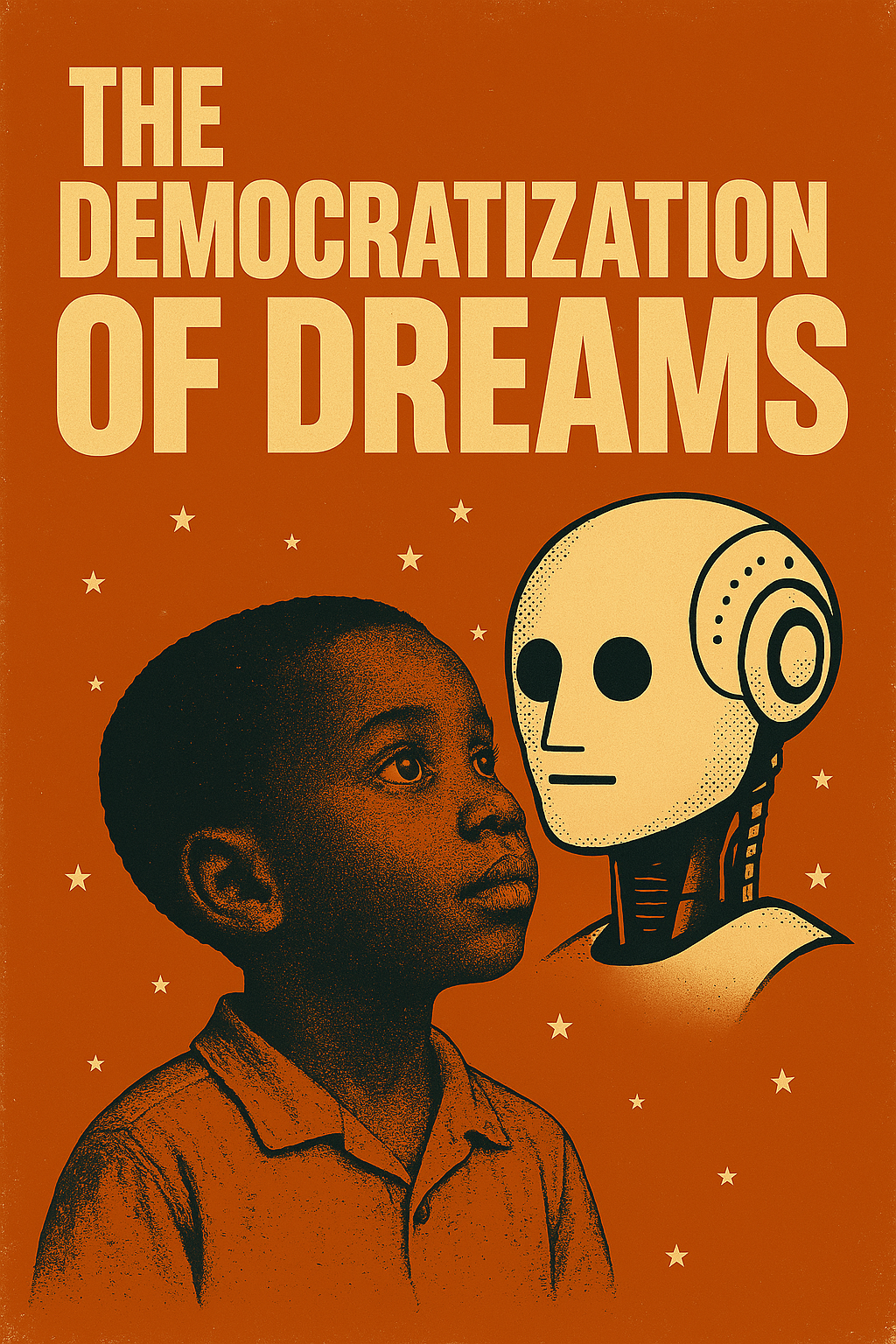
Imagine a boy in Somalia, raised in a culture with no operatic tradition, who nonetheless hears in his head the kind of sonic drama that Puccini might have admired.
He has no access to a conservatory, no orchestra, no studio, no audience. A decade ago, his dream would remain confined to memory and melody. Today, he can prompt a multilingual AI to compose an original aria, generate accompanying visuals, and even animate a stage. The result may not may not rival La Scala — but it exists. It lives outside his mind. It can be seen, shared, critiqued. It can evolve.
In Mumbai, a garment worker’s daughter uses open-source diffusion models to design digital fashion lines inspired by Marathi folklore, pushing her work directly into international visual channels. In Bogotá, a teenager experiments with AI-generated choreography based on traditional cumbia rhythms and uploads the resulting short film onto platforms that previously only served the capital elite. In northern Vietnam, a coffee farmer builds AI-generated narratives around his family’s farming rituals, turning them into immersive brand stories for the global ethical coffee market.
These aren’t case studies from glossy NGO decks. They’re fragments from a new reality where access begins not with funding but with interface.
Narrative Without Permission
What AI enables is not a uniform flattening of creativity, but a pluralisation.
In the past, to have a voice often meant learning a specific visual or narrative grammar — usually Western, often urban, always institutional. Now, a creator in Port Harcourt doesn’t need to conform to Vogue’s visual canon to tell a compelling fashion story. She can use AI to generate stories rooted in local idioms, colours, rituals — and still match the technical quality of global output.
This is particularly potent in brand storytelling. Historically, commercial storytelling has been centralised, designed by a narrow class in big cities and broadcast to the rest. AI disrupts this by enabling distributed creativity. Local creators can now produce high-quality visual narratives that reflect the lived texture of their culture — stories that brands are increasingly hungry for, but rarely authentic in sourcing.
A coconut oil brand in the Philippines can now collaborate with local AI storytellers to generate product videos that don’t imitate Western advertising, but instead tell stories of ancestral care, ocean rhythms and post-colonial identity. A sneaker brand working with urban South African designers can explore Afrofuturist narrative spaces that blend township culture with digital surrealism — at production costs that were once prohibitive.
Robot Story are already making this accessible — allowing storytellers from any background to create polished, culturally rich videos for commercial use. It’s not about exporting a style, but enabling new centres of creative gravity to form.
From Gatekeepers to Navigators
This isn’t to suggest that AI has removed all barriers.
Access to stable electricity, data, devices and language fluency remain real constraints. And the platforms that host this new creative output still follow algorithms shaped by market dynamics and entrenched bias. But what has shifted is the question of permission. You no longer need a visa to contribute to the global cultural economy. You need bandwidth, vision and fluency in prompting.
Curation, not access, becomes the next frontier. Which stories are elevated? Who gets paid? How do we avoid algorithmic mimicry that turns diverse storytelling into pastiche? These are live questions. But they are better questions than the quiet exclusions that defined the previous era.
The End of the Talent Myth
There’s a dangerous romanticism that clings to the idea of ‘raw talent discovered’. The narrative of the slumdog virtuoso found by a record producer, the prodigy lifted from obscurity by Western recognition. AI burns this myth down. It removes the need for discovery and replaces it with distribution. The Somali boy doesn’t need to be found. He just needs to upload.
That’s why services like Robot Story matter — because they don’t just give people a tool, they give them an outlet. Almost anyone with the right motivation and interest can now build high-production-value stories that move beyond templates and into cultural texture.
This shift is not a technological miracle. It’s a redistribution of power, and like all redistributions, it comes with noise, distortion and risk. But underneath it, something vital is happening. The global creative landscape is no longer a matter of centre and periphery. It is a web. A network of stories, emerging simultaneously, made by people who don’t need to ask before they speak.
For brands, this represents both an opportunity and a challenge. The most resonant brand stories in the years ahead won’t come from inside the boardroom. They’ll be authored by voices that, until now, had no microphone. Brands that understand this — and listen, commission, co-create — will not only be more relevant. They will be more true.